
The Changeable Wave
reflections on a wet year


Water, in the cultural imaginary, operates as a metaphor for movement, fluidity, time, and transformation. Currents and fog as memories moving fast or lingering. Rain as letting go. You can never step in the same river twice. But water’s changeability isn’t just a metaphor. Water is change; it is a physicalized form of change that we can perceive with our human senses, those porous organs of reciprocity through which the inner and outer worlds mix and merge.
The hydrologic cycle– the continuous circulation of water from earth to atmosphere and back– is not a simple circle but many processes happening at once. Wetness seeps, pools, drips, evaporates, pours, falls and flows in multiple temporal registers, with some molecules cycling rapidly through the atmosphere in days, while others move through the deep earth in geological timescales. And of course, these state changes are not separate but concurrent, interpenetrating, and overlapping.
Throughout this year, I have been thinking with water. We are, as it is often stated, roughly 60% water. We are wetlands. We experience tidal shifts of freshwater mixing with our salty seas, a continuous exchange across membranes, the osmotic shifting and rebalancing of salinities. We are atmosphere; the heat and moisture in our bodies become weather for other forms of life in and outside of our bodies. We swell, rage and cycle, and when we drink, leak, eliminate, ejaculate, cum or cry, the whole hydrologic cycle moves through us.
However much we might recognize this fluid fact of our corporeal constitution, we are habituated to see our human selves as solid, occupying time and space in a stable shape called human that is separate from the aqueous worlds around us. Corollary to this solidness is a propensity to conceive of change as a force acting on something fixed, resulting in variation within a framework of coherence. Stability, not fluidity, is the norm, the constant.
I often think of a passage from the novel Lighthousekeeping, by Jeanette Winterson. The novel follows the lineages of two families: The Pews, who were blind lighthouse keepers, time traveling through the darkness through the weaving of stories, and the Darks, clergymen who struggled with the darkness inside. The story of Babel Dark is set in the nineteenth century, when Charles Darwin was opening up questions in the foundations of belief previously considered firm and unmovable. Troubled by the idea of a constantly changing, evolving world, Babel Dark asks:
“Why would God make a world so imperfect that it must be continually righting itself?” He feels seasick at the thought and thinks “if the movement in him was like the movement in the world, how would he ever steady himself? There had to be a stable point somewhere. He had always clung to the unchanging nature of God, and the solid reliability of God’s creation.” He sings to himself a hymn he likes. “Fastened to the rock which cannot move, grounded firm and deep in the Saviour’s love…Fastened to the rock. That was the town crest here at Salts; a sea village, a fishing village, where every wife and sailor had to believe that the unpredictable waves could be calmed by a dependable god. Suppose the unpredictable wave was God”
God as the unpredictable wave. And if we are made of that same godstuff, then we, too, are divinely wet. We are unknowable waves whose divinity lies not in our capacity to return to a known shape or source, but to keep moving and transforming.
How predictable are waves, and what are the limits of that predictability? Does perceiving change in ourselves require a preexisting fidelity to coherence, to believing oneself to be a stable idea? Do we need to first understand ourselves as something knowable, predictable with identifying features and consistent patterns of behavior, a solid thing, in order to consider ourselves otherwise? Does change require that there is a not-change, a stasis, that is then disrupted by an instigating force, a catalyzing wind, an idea that, once thought, ignites a fire that cannot be put out until everything it touches alchemizes into exothermic transformation and spreading heat?
There are moments when we are in its happening, when we are no longer the I who changes but are bodying change, when we are, as a friend wrote, more water than woman. The “I” that is being continuously enacted through entanglements—with water, with flesh bodies and soil bodies, with food, sex, desire, grief, with art, with partners, friends, family, community, with death— loses the narrative, the storied lines of separation. Our distinctness dissipates and we do not recognize ourselves. These are moments when the circumstances of our lives aren’t a gentle invitation to embrace change, but to recognize that this is the condition of living.
This year was that for me. It was the wave that carried me, the me that is the wave.
Suppose the unpredictable wave was God. These are the kinds of propositions to which I have been offering safe harbor, and in the offering, they erode my banks, destabilize my breakwater, and wash away any notions that there is a harbor to return to or safety to give. It is, at times, an uncomfortable way of bodying this human experience, but there’s something in living with these questions that opens, for me, the possibility of being awake to a truly responsive, from-the-sediment kind of living relational ethics.
And so I have had no choice but to be taken by the wave, and once submerged, to listen with my wetness. My conversations with water are polyvocal; they speak with me in gestures, in weather, art and books. They have flooded all of my collaborations, blurring any claims to ownership. I feel the pull of them from the buried springs that I am just now, after a year of talking with researchers and water-keepers, learning to identify. I feel them as I watch the sunset from Valentino Pier, wondering and worrying over the fate of our changing Red Hook waterfront.I feel these conversations raining into me from the mysterious liquid skies painted by my lover, in the moisture rising up from my skin when I try to hold the oceanic immensity of her in my mind.
I am an artist who loves the kinds of exploration that can happen through philosophical frameworks. Theory, to me, is wet, messy and alive. I don’t think of it as disembodied, separate from what the body does and knows. Neither is it separate from my studio practice. The studio is a place where my body gets to think philosophically through process and material encounter. Theoretical languages emerge from it; they are neither pre-existing and predictive nor explanatory and applied after the fact, but are co-emergent with an open-ended process of inquiry and enjoyment.
Always hungry for the new colors that words can carry, I have been living intimately with ideas from writers and artists whose work probes the boundaries of our humanness, who question the conceptual containers that demarcate the ways we inhabit our bodies and relations, whose work reshapes or rewilds the worldings that produce and perpetuate horizons of possible life-living. Their thinking scores the membranes of my confabulations, allowing for new pathways to flow, intersect, converge. These colors shift the way I sense, in public, in private, in my bathtub, where I trace patterns in my skin with these thoughts in my fingertips. In the mobius strip of in-out that is thought thinking in flesh, concepts converge. So too in my studio, pressing slurries of water and colored paper into shapes that emerge from drawings, from dense genealogies of artistic explorations.

This pull towards the fluid, the permeable, animates my practice, a practice that has developed to operate at multiple scales—from intimate drawings and mixed-media wall pieces to multi-media collaborative projects to creating and directing participatory experiences and events. The year began with To Live As These Animals: Held in Wet, an event I hosted at the Francis Kite Club, that engaged the adventurous attendees in an explorative drawing and writing journey into underground waters, accompanied by monsters and ghosts. Part story telling, part Drawing on the Senses, part group mad libs, this project was the beginning of my water year. My research for it introduced me to the work of Dilip da Cunha and Anuradha Mathur, whose book The Invention of Rivers became a whole wet world of exploration and the conceptual groundwater for Liquid Cartographies: Reshaping the Banks of the Possible, a 4-day experimental festival in Red Hook, Brooklyn, co-created by myself and The Emergence Network.
In fluid dynamics, a fluid is defined as something that continuously transforms under constant pressure. This year exemplified this in my personal life, with the passing of my father in February, all of the changes in my body that come with being a woman in midlife, with grief, with falling in love with a woman after a lifetime of dating men, and so many other transformations too large and small, too wet to name. And in my work as well. The night before the Liquid Cartographies festival began, the historic warehouse at 481 Beard Street that housed dozens of art studios and small businesses, that comprised so much of the active and vibrant Red Hook arts community, caught fire. The fire, and the ensuing water damage from the firefighting efforts, devastated the building and all of the materials and works inside, including the Red Hook Open Studios Ten Year Anniversary show, which included my artwork as well, all of the print materials awaiting pick-up for the festival, which included the creative and intellectual labor of all those who contributed (thank you, Sofia Batalha) to designing them, and the installation in process by Ethan Cornell. This building was also slated to be our main festival meeting space. So in grief and shock, under the smoke and ash filled sky, we let the transformations, already in motion, continue to move through us. We responded as best we could and hosted attendees from near and far in an event that was so much more an emergent response to concepts and places in constant flux than we ever could have imagined.
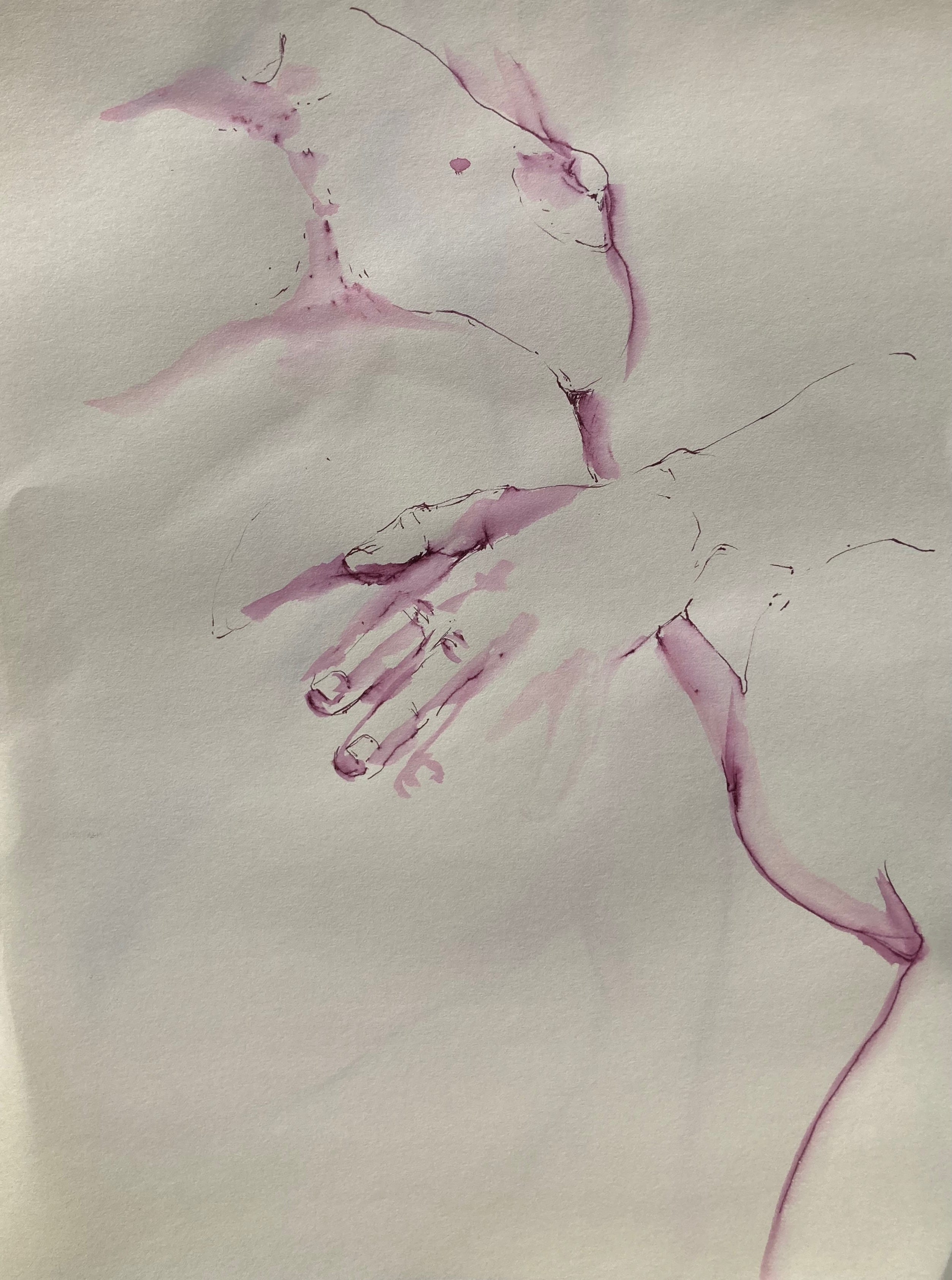
Residence time is the term given to the average time a water molecule spends in a particular reservoir before moving to the next one. The waves of change that have been breaking through my life this year have been portaled into this timeline via punctuating events. But I wouldn’t say that these events precipitated the changes. They are threshold moments, yes, but their precipitation is asynchronous and cumulative. They are moments when perception shifts, just as condensation makes wetness visible as clouds, which touch our skin in the form of rain. Who knows how long our waters need to rest in deep underground reservoirs before they are ready to travel up or out? If we are 60% water, what amount of that wetness rushes to meet a moment, tipping it towards another form, another way of being perceived, while the remaining reserves wait? There isn’t a discrete before and after to the hydrologic cycle, and neither is there to the wild divinity of being wave.
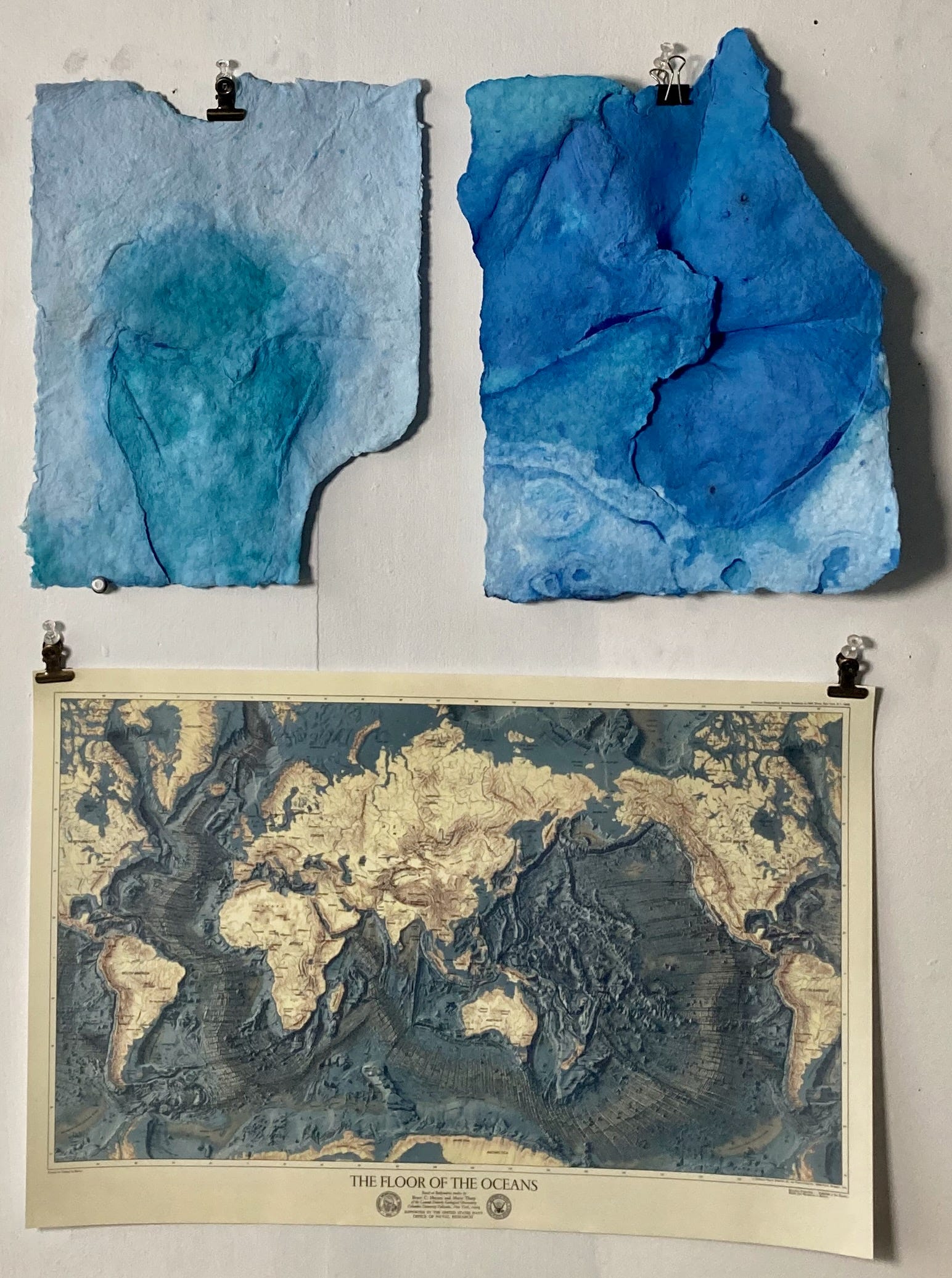
I will be continuing the deep dive into this exploration in the coming year, working through a blend of theory and personal reflection in a book project, as well as in my new cast paper series Her Ocean Floor, a title inspired by Marie Tharp, the geologist and oceanographic cartographer to first map the mysterious topography below the Atlantic. Transformation, via material acts of transliteration, will be the theme for my Drawing on the Senses classes this year. And I am sure that other projects will open new tributaries of exploration. I am looking forward to the changes ahead, and will continue to ask what it means to be both harbor and wave, to listen, learn and love with all the wetness I am.
So beautiful for this era of CHANGE. 💙